There were two major plague epidemics in this country – the Great Plague of the 1600s, and The Black Death of the 1300s. Today we will be looking at the latter.
The less than cheery title is more than apt for this dreadful happening. So what is the Black Death? A horrible illness, similar in symptoms to those I described in my last blog post, the Black Death is thought to have originated in Egypt. There
was also a major epidemic in China, which spread throughout Asia, Europe and then to Britain. The Black Plague in Europe began around 1347 and killed over a quarter of the population. One year later it had reached England.
One of the theories of how the plague spread points to the Mongol Empire. Rulers, who had been in battles across Asia and Europe, would settle in various places across the continents for trade. Italian merchants would come for silks and spices, which had a very high value in Europe. However, the traders brought with them Asian black rats, which were carrying the fleas which had been infected by the plague. The rats made their way into the traders’ supplies. By the time the supplies had arrived back in Italy, half the supply ships’ crews had already died or were dying of the plague. It did not take long for the disease to spread throughout Europe.
So victims of the plague were dropping dead everywhere. The disease was fast-moving and ruthless, and could spread around an entire town within weeks. Death became so commonplace that people of the Middle Ages thought that the world was going through an apocalypse. Of course, poor sanitation and a lack of scientific and medical knowledge certainly didn’t help matters.
From large towns to small villages, people prayed fervently to God but their prayers went unanswered. And for those struck down, even their religion held little comfort. Not all the sick could be given religious last rights because there simply were not enough clergymen to deal with the rapidly dying population. Worse still, some men of the church simply refused to provide these blessings for fear of catching the plague themselves.
When God wouldn’t answer their prayers, a group of people decided to go to extreme measures to make God listen. They were the Flagellants. They would gather around in towns and beat themselves to atone for their sins. This group had been in existence before this time, but their extreme nature, and the fact that the traditional church was not helping out as much as people would have liked during this terrible time, meant that more and more people joined them.
A famous Italian writer, Giovanni Boccaccio, wrote his book The Decameron during the time of the plague. This tells us a lot about how the plague spread and affected people. He said: “The years of the beatific incarnation of the Son of God had reached the tale of one thousand three hundred and forty eight when in the that deadly pestilence, which, whether disseminated by the influence of the celestial bodies, or sent upon us mortals by God in His just wrath by way of retribution for our iniquities [sins] had had its origin some years before in the East.” (page 26 of the link)
“The evil went yet further for not merely by speech or association with the sick was the malady communicated to the healthy with consequent peril of common death; but any that touched the cloth of the sick or aught else that had been touched or used by them seemed thereby to contract the disease.” (27)
“Many died daily or nightly in the public streets; of many others, who died at home, the departure was hardly observed by their neighbours until the stench of their putrefying bodies carried the tidings; and what with their corpses and the corpses of others who died on every hand the whole place was a sepulchre” (31-32)
All in all, a grim time, and what’s worst, it wasn’t the last the people of England, and in particular London, had seen of the plague.
NEXT TIME: THE GREAT PLAGUE OF THE 1600s
And finally
Here is an interview I did last week at The Sweet Bookshelf
Showing posts with label time-travel. Show all posts
Showing posts with label time-travel. Show all posts
Thursday, 13 May 2010


Tuesday, 23 March 2010
The carriage passes what looks like Westminster Palace (minus Big Ben) and eventually turns into a narrow street
I used this quote before when I did my post on London Bridge. Today we will look at Westminster Palace. Or as you know it – The Houses of Parliament.
The Palace of Westminster began as a church, and was built in the eighth century - dedicated to St Peter. The name West Minster came from the phrase meaning west monastery. In the tenth century, after being converted into an abbey, it was adopted as a royal church. It was then that the idea of having a Palace of Westminster was born.
The Palace of Westminster was inherited by William the Conqueror after the great battles of 1066. In 1097, his son William II began to use Westminster Hall to hold grand banquets and it was becoming known as the “ceremonial centre of the Kingdom”. At this time the capital of England was actually Winchester, as this was where the Royals spent most of their time.
Over the next century, Westminster was gradually becoming the centre of the country. This was especially so under the rule of Henry II’s son, King John, when the Exchequer moved to Westminster.
It took 400 years, but finally, in 1512, the Palace of Westminster to become the permanent home of Parliament.
The Clock Tower that we call Big Ben, on the other hand, wasn’t completed until 1859, but this wasn’t the first of its kind. In fact, during Amelia’s time England was up to its second clock, which was built in 1367 but by 1707 it had fallen into disrepair and was replaced with a sundial. After a fire in 1834, which burnt down most of the Palace of Westminster, building work began on a new palace.
Like all political centres, there have been some great historic moments in the Palace of Westminster. Let’s look at our favourite period – the 1600s:
In 1605 Guy Fawkes and 12 others tried to blow up the House of Lords in the infamous Gunpowder Plot. They were prosecuted in 1606.
In 1649, King Charles I was sentenced to death after the Civil Wars between the Royalists and the Parliamentarians. In 1653, Oliver Cromwell was instated as the Lord Protector, and England became a Republic. After his death in 1658, he was succeeded by his son, Richard. However the people of England called for Charles II to come back and England had a monarchy again in 1660. In autumn of that year, it was ordered that Cromwell and two others be exhumed (i.e. have their bodies dug up after death), and executed for regicide (or murder of royalty). On the 30th January 1661 (twelve years after the death of Charles I), they were hanged and then decapitated. Their heads were put on display on poles above Westminster Hall.
In 1688, seven bishops were tried because they objected to the Declaration of Indulgence, which stated that people did not have to declare their oath to the church in public and were free to worship as they wished in the privacy of their own homes. It was the first step towards religious freedom, but the objection from the bishops resulted in a trial for seditious libel. They were found not guilty.
I used this quote before when I did my post on London Bridge. Today we will look at Westminster Palace. Or as you know it – The Houses of Parliament.
The Palace of Westminster began as a church, and was built in the eighth century - dedicated to St Peter. The name West Minster came from the phrase meaning west monastery. In the tenth century, after being converted into an abbey, it was adopted as a royal church. It was then that the idea of having a Palace of Westminster was born.
The Palace of Westminster was inherited by William the Conqueror after the great battles of 1066. In 1097, his son William II began to use Westminster Hall to hold grand banquets and it was becoming known as the “ceremonial centre of the Kingdom”. At this time the capital of England was actually Winchester, as this was where the Royals spent most of their time.
Over the next century, Westminster was gradually becoming the centre of the country. This was especially so under the rule of Henry II’s son, King John, when the Exchequer moved to Westminster.
It took 400 years, but finally, in 1512, the Palace of Westminster to become the permanent home of Parliament.
The Clock Tower that we call Big Ben, on the other hand, wasn’t completed until 1859, but this wasn’t the first of its kind. In fact, during Amelia’s time England was up to its second clock, which was built in 1367 but by 1707 it had fallen into disrepair and was replaced with a sundial. After a fire in 1834, which burnt down most of the Palace of Westminster, building work began on a new palace.
Like all political centres, there have been some great historic moments in the Palace of Westminster. Let’s look at our favourite period – the 1600s:
In 1605 Guy Fawkes and 12 others tried to blow up the House of Lords in the infamous Gunpowder Plot. They were prosecuted in 1606.
In 1649, King Charles I was sentenced to death after the Civil Wars between the Royalists and the Parliamentarians. In 1653, Oliver Cromwell was instated as the Lord Protector, and England became a Republic. After his death in 1658, he was succeeded by his son, Richard. However the people of England called for Charles II to come back and England had a monarchy again in 1660. In autumn of that year, it was ordered that Cromwell and two others be exhumed (i.e. have their bodies dug up after death), and executed for regicide (or murder of royalty). On the 30th January 1661 (twelve years after the death of Charles I), they were hanged and then decapitated. Their heads were put on display on poles above Westminster Hall.
In 1688, seven bishops were tried because they objected to the Declaration of Indulgence, which stated that people did not have to declare their oath to the church in public and were free to worship as they wished in the privacy of their own homes. It was the first step towards religious freedom, but the objection from the bishops resulted in a trial for seditious libel. They were found not guilty.
Monday, 15 March 2010
‘Once we are at St James’s Square, Mama shall send Jones for the doctor at once. Try not to worry, darling Amelia.’
When writing this book I thought that it would be important to use places that had some historical significance during the time, and that included all the roads. Today let’s talk about the origins of St James’s Square.
St James’s Square may now be filled with embassies, company head offices and office blocks, but during Amelia’s time, the Square was the home to some of the most exclusive houses that money could buy. This was the intention from the beginning.
Building work began in 1662 after King Charles II extended a lease to Henry Jermyn, 1st Earl of St Albans, who had already developed the nearby St James Street. When the lease extension was granted, he believed that it was important that the area should be “built for the conveniency of the Nobility and Gentry who were to attend upon his Majestie's Person, and in Parliament; and for the better Ornament of the Place, Directed by his Officers, not only the said Buildings, but the form and Manner also”*. What this meant that St James’s Square was only meant to be built for the people who absolutely had to be in the area for business purposes. Therefore the only people who could live there would be from the highest classes.
He added: “ye beauty of this great Towne and ye convenience of your Court are defective in point of houses fitt for ye dwellings of Noble men and other Persons of quality, and that your Majesty hath thought fitt for some Remedy hereof to appoint [that the] Place in St. James Field should be built in great and good houses”*. In short, the richest folk would be and should be the only people that live in this exclusive part of London. By the 1720s seven earls and seven dukes lived in St James’s Square.
This is a rather interesting request from someone who had a gambling problem and was rumoured to marry the widow of King Charles I, Henrietta Maria, not long after the death of the King.
*From: 'St. James's Square: General', Survey of London: volumes 29 and 30: St James Westminster, Part 1 (1960), pp. 56-76. URL: http://www.british-history.ac.uk/report.aspx?compid=40545 Date accessed: 15 March 2010.
When writing this book I thought that it would be important to use places that had some historical significance during the time, and that included all the roads. Today let’s talk about the origins of St James’s Square.
St James’s Square may now be filled with embassies, company head offices and office blocks, but during Amelia’s time, the Square was the home to some of the most exclusive houses that money could buy. This was the intention from the beginning.
Building work began in 1662 after King Charles II extended a lease to Henry Jermyn, 1st Earl of St Albans, who had already developed the nearby St James Street. When the lease extension was granted, he believed that it was important that the area should be “built for the conveniency of the Nobility and Gentry who were to attend upon his Majestie's Person, and in Parliament; and for the better Ornament of the Place, Directed by his Officers, not only the said Buildings, but the form and Manner also”*. What this meant that St James’s Square was only meant to be built for the people who absolutely had to be in the area for business purposes. Therefore the only people who could live there would be from the highest classes.
He added: “ye beauty of this great Towne and ye convenience of your Court are defective in point of houses fitt for ye dwellings of Noble men and other Persons of quality, and that your Majesty hath thought fitt for some Remedy hereof to appoint [that the] Place in St. James Field should be built in great and good houses”*. In short, the richest folk would be and should be the only people that live in this exclusive part of London. By the 1720s seven earls and seven dukes lived in St James’s Square.
This is a rather interesting request from someone who had a gambling problem and was rumoured to marry the widow of King Charles I, Henrietta Maria, not long after the death of the King.
*From: 'St. James's Square: General', Survey of London: volumes 29 and 30: St James Westminster, Part 1 (1960), pp. 56-76. URL: http://www.british-history.ac.uk/report.aspx?compid=40545 Date accessed: 15 March 2010.
Wednesday, 3 March 2010
“Oh, my dear, my darling Elizabeth has the smallpox.”
The Dresskeeper tries to highlight some of the problems people faced during the 17th century, and disease was an issue than affected everyone – rich or poor.
So what is smallpox? Well, it’s a virus, which according to the World Health Organisation, starts off with symptoms a lot like the flu, but is then followed by a rash and blisters (or pustules). These start on the face and quickly spread everywhere else. Smallpox still is one of the most dangerous and feared diseases in the world, but a few hundred years ago, the disease killed around 30% of those infected. If you didn’t die you would probably end up with scars - almost 80% who survived sported them. And if the scars weren’t enough, you might also be blinded.
In 1967 the World Health Organisation began a programme to eradicate Smallpox completely around the globe and by 1980, they had managed it.
However, during Amelia’s time, and in the case of her poor friend Elizabeth, smallpox was impossible to treat, and there were no vaccinations or preventative medicines. The worst part of it was that a person could be infected for many days and not even realise it. It was easy to see how it spread. That fever could last for around 10 days and by the time the worst of the symptoms would become visible – the pox – that person could have infected so many others. And in a crowded city like London, the virus spread like wildfire.
Finally, in the 1700s, medical professionals began to consider immunization after noticing that a person who had survived smallpox could not be re-infected.
Interestingly, the idea of immunisation was controversial. An article written in 1750 for Gentlemen’s Magazine highlights the arguments against inoculation. For example, it was supposedly against God, as he is the “sovereign of life, and he can preserve us”. A trust in God was considered enough in the fight against the disease. Another argument against immunisation was that giving a child a jab took away their free will in some way, because they were those “who cannot judge for themselves.” And yet another argument was that it was unlawful because “it may bring danger without their knowledge”. In other words, if a person was infected with smallpox for medical purposes, they couldn’t be sure if they carried the disease, and therefore it they might infect others.
Luckily, this article was written by a man named David Some, who was in favour of the jabs. In his view, there were two options – stay out of everyone’s way all the time (obviously impractical) or immunise. He successfully argued immunisation was the safest way to save lives.
Then, in the latter half of the 18th century Edward Jenner noticed that people like milkmaids did not seem to get smallpox - instead they were only infected by the much milder cow pox. He carried out an experiment on an eight-year-old boy named James Phippes. In a gross but necessary act, he took pus out of the pustule from a cowpox sufferer and rubbed it into a cut on the boy’s arm. The boy did not get smallpox.
Unfortunately, not everyone believed in his experiment and the claim that the boy would never get smallpox, so more proof was needed. Jenner continued to try his experiments on other children, which didn’t go down too well with 18th century ‘do-gooders’. Nevertheless, Jenner eventually convinced the powers that be in the benefits of his work, and a vaccine against smallpox was introduced.
The Dresskeeper tries to highlight some of the problems people faced during the 17th century, and disease was an issue than affected everyone – rich or poor.
So what is smallpox? Well, it’s a virus, which according to the World Health Organisation, starts off with symptoms a lot like the flu, but is then followed by a rash and blisters (or pustules). These start on the face and quickly spread everywhere else. Smallpox still is one of the most dangerous and feared diseases in the world, but a few hundred years ago, the disease killed around 30% of those infected. If you didn’t die you would probably end up with scars - almost 80% who survived sported them. And if the scars weren’t enough, you might also be blinded.
In 1967 the World Health Organisation began a programme to eradicate Smallpox completely around the globe and by 1980, they had managed it.
However, during Amelia’s time, and in the case of her poor friend Elizabeth, smallpox was impossible to treat, and there were no vaccinations or preventative medicines. The worst part of it was that a person could be infected for many days and not even realise it. It was easy to see how it spread. That fever could last for around 10 days and by the time the worst of the symptoms would become visible – the pox – that person could have infected so many others. And in a crowded city like London, the virus spread like wildfire.
Finally, in the 1700s, medical professionals began to consider immunization after noticing that a person who had survived smallpox could not be re-infected.
Interestingly, the idea of immunisation was controversial. An article written in 1750 for Gentlemen’s Magazine highlights the arguments against inoculation. For example, it was supposedly against God, as he is the “sovereign of life, and he can preserve us”. A trust in God was considered enough in the fight against the disease. Another argument against immunisation was that giving a child a jab took away their free will in some way, because they were those “who cannot judge for themselves.” And yet another argument was that it was unlawful because “it may bring danger without their knowledge”. In other words, if a person was infected with smallpox for medical purposes, they couldn’t be sure if they carried the disease, and therefore it they might infect others.
Luckily, this article was written by a man named David Some, who was in favour of the jabs. In his view, there were two options – stay out of everyone’s way all the time (obviously impractical) or immunise. He successfully argued immunisation was the safest way to save lives.
Then, in the latter half of the 18th century Edward Jenner noticed that people like milkmaids did not seem to get smallpox - instead they were only infected by the much milder cow pox. He carried out an experiment on an eight-year-old boy named James Phippes. In a gross but necessary act, he took pus out of the pustule from a cowpox sufferer and rubbed it into a cut on the boy’s arm. The boy did not get smallpox.
Unfortunately, not everyone believed in his experiment and the claim that the boy would never get smallpox, so more proof was needed. Jenner continued to try his experiments on other children, which didn’t go down too well with 18th century ‘do-gooders’. Nevertheless, Jenner eventually convinced the powers that be in the benefits of his work, and a vaccine against smallpox was introduced.
Monday, 22 February 2010
Ghost Stories ...
As many of you know, I am currently in the process of writing my second book The Plaguemaker. This one is different from The Dresskeeper in that it is a ghost story. My main character is being haunted by the ghost of a young girl who died during the Plague of 1665, all because her father is unknowingly building on one of London’s many plague pits created at the time. So today, instead of looking at the history behind The Dresskeeper, I thought I would do a post on tales of ghostly happenings in London, all from the 17th century, of course.
This may not be for the faint hearted.
The Volunteer Pub on Baker Street was built over the remains of a 17th century mansion that was inhabited by the fearsome Neville family. Their mansion was burnt down in 1654, ending the “reign of terror” of this ‘mob’ family over the town. Rumour has it that the patriarch, Richard Neville, haunts the original 17th century cellars of this North London pub dressed “in surcoat, breeches and lavish stockings.” The ghost story is a claim to fame of this establishment, where even TV’s ‘Most Haunted’ paid a visit to try and remove this ghost.
The Old Queen’s Head on Essex Road in Islington dates back to the 17th century and is also home to a ghost story or two. One prominent tale involves a woman and a crying girl. Some have heard feet running around while others have witnessed the young girl running up the stairs and slamming doors. She is also often heard weeping. According to The Metro the two women met a very sticky end but I can’t establish what that end was. Feel free to fill me in!
The George pub on The Strand has been linked to a ghost that seems to be from the 17th century. A Cavalier (from the Royalist side of the 17th century civil war) has been wandering the cellar. A funny story dates from the 1970s when the pub was being refurbished. It involves an extremely frightened decorator who came running from the cellar after a man who looked “all ‘istorical like” was staring at him. The landlord gave him a brandy and told him not to worry, because “my wife sees him all the time.”
The Queen’s House in Greenwich was built in 1635. It was commissioned by Anne of Denmark, wife of James I. Apparently it was built for her as an apology after James I swore at her in public because she shot one of his dogs while hunting (as you do!). The Queen’s House ghost was first seen in a photograph taken in 1966 after a retired couple from Canada visited London on holiday. When they returned home and developed their pictures they saw the ghostly figure standing on the bottom of the staircase. Take a look at the picture on the Queen’s house website and you can see a ghostly left hand on the rails.
The Pond Square Ghost is an interesting story. This ghost is not human, but is in fact, a chicken. On morning in January 1626, Sir Francis Bacon (philosopher, author, scientist, lawyer, among other things) was trying to see if refrigeration was a good way of preserving meat. After buying the chicken from Highgate Hill, he killed and plucked the chicken and filled it up with ice. Bacon was the unlucky one as he caught pneumonia from this experiment and died not long later. Since then, Pond Square has been the sight of numerous visits from a ghostly plucked chicken frantically running about.
Well, that’s it for this week. As you may have noticed three of these ghostly sightings seem to take place in pubs, so it is up to you whether or not you believe these tales of the paranormal, given the amount of alcohol that may or may not have been consumed during the sightings! Either way, it provides a little respite from our serious modern lives, doesn’t it?
All the best,
Mary.
This may not be for the faint hearted.
The Volunteer Pub on Baker Street was built over the remains of a 17th century mansion that was inhabited by the fearsome Neville family. Their mansion was burnt down in 1654, ending the “reign of terror” of this ‘mob’ family over the town. Rumour has it that the patriarch, Richard Neville, haunts the original 17th century cellars of this North London pub dressed “in surcoat, breeches and lavish stockings.” The ghost story is a claim to fame of this establishment, where even TV’s ‘Most Haunted’ paid a visit to try and remove this ghost.
The Old Queen’s Head on Essex Road in Islington dates back to the 17th century and is also home to a ghost story or two. One prominent tale involves a woman and a crying girl. Some have heard feet running around while others have witnessed the young girl running up the stairs and slamming doors. She is also often heard weeping. According to The Metro the two women met a very sticky end but I can’t establish what that end was. Feel free to fill me in!
The George pub on The Strand has been linked to a ghost that seems to be from the 17th century. A Cavalier (from the Royalist side of the 17th century civil war) has been wandering the cellar. A funny story dates from the 1970s when the pub was being refurbished. It involves an extremely frightened decorator who came running from the cellar after a man who looked “all ‘istorical like” was staring at him. The landlord gave him a brandy and told him not to worry, because “my wife sees him all the time.”
The Queen’s House in Greenwich was built in 1635. It was commissioned by Anne of Denmark, wife of James I. Apparently it was built for her as an apology after James I swore at her in public because she shot one of his dogs while hunting (as you do!). The Queen’s House ghost was first seen in a photograph taken in 1966 after a retired couple from Canada visited London on holiday. When they returned home and developed their pictures they saw the ghostly figure standing on the bottom of the staircase. Take a look at the picture on the Queen’s house website and you can see a ghostly left hand on the rails.
The Pond Square Ghost is an interesting story. This ghost is not human, but is in fact, a chicken. On morning in January 1626, Sir Francis Bacon (philosopher, author, scientist, lawyer, among other things) was trying to see if refrigeration was a good way of preserving meat. After buying the chicken from Highgate Hill, he killed and plucked the chicken and filled it up with ice. Bacon was the unlucky one as he caught pneumonia from this experiment and died not long later. Since then, Pond Square has been the sight of numerous visits from a ghostly plucked chicken frantically running about.
Well, that’s it for this week. As you may have noticed three of these ghostly sightings seem to take place in pubs, so it is up to you whether or not you believe these tales of the paranormal, given the amount of alcohol that may or may not have been consumed during the sightings! Either way, it provides a little respite from our serious modern lives, doesn’t it?
All the best,
Mary.
Monday, 15 February 2010
‘I will never marry you, you nutjob,’ I spit, but it doesn’t have the desired effect.
‘Luckily, I don’t need your permission.’
‘Yes you do.’
He grins. All I need is my friend, a minister at Fleet, to do the honours. And we are on the way there now.’ He leans I again. Once it’s done it can never be undone. That’s the law.’
Oh dear, that sounds grim, doesn’t it. Yet in the 17th century, marriage cost a lot of money, and it was the girl, or her father, who paid. In effect, it was a deal or business transaction, organised by the father and the prospective groom. A young girl who’s father was able to provide a big enough dowry on her behalf would be married – though not necessarily to a man she loved. And worse still, if the groom thought that the payment was not enough then he could change his mind and conduct his ‘business’ elsewhere. The prospective wife, usually a girl of no more than fourteen or fifteen, had little or no say.
Still, the phrase “until death do us part” meant a lot more then. Divorces were difficult to obtain and besides, they were not really necessary. This was not because Londoners in 1685 were better at making marriages stick. Thanks to the high mortality rates, particularly in childbirth, and life expectancy hovering at around 35 to 40, married couples would not stay married for long. Nevertheless, the women at the time managed to encounter many problems during their short married lives.
The society was hierachical and men made the rules and subsequently enjoyed all the rights.
The Norton Anthology of English Literature tells us that this power was claimed as it related to God and King (both being male) and their respective rule over their kingdoms. A husband’s position of power was obvious from the get-go, reflected in the vow “Love, honour and obey.” Nowadays, we have a choice whether or not to recite this vow, but for the 1685 woman, it was a legally binding agreement. Obey applied to all areas of marriage, including the bedroom, where a woman’s “I do” was an implied consent for the man to do whatever pleased him.
Even worse, women of the time had no right to property, money and or even to her own children. Everything that she owned prior to marriage became the property of her husband. The only way a woman could have some say in how she lived her life would be if she became a widow – as long as her husband’s heirs didn’t throw her onto the street.
As I’ve said, divorce was available, in the form of an annulment, but only the very rich were able to have their marriages annulled, because proving to the church and court that a marriage was not legal in the first place was both expensive and time-consuming. A man’s infidelity was not a reason to divorce, but not surprisingly, a woman’s was. According to The History of Women, a woman found guilty of adultery, or the deliciously named ‘criminal conversation’, would promptly be stripped of her status, money and children, without recourse.
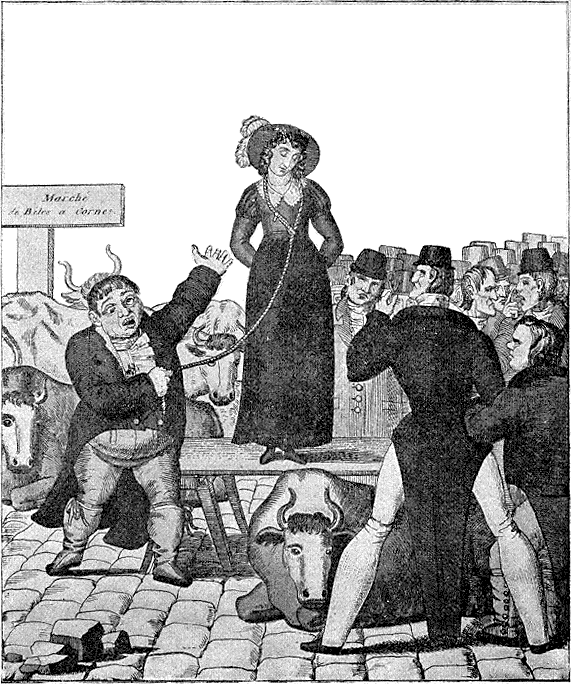
And if that seems unfair, read on. Another way of getting a rid of a woman was to sell her. Click on this link to see an image of woman on a platform with a noose around her neck held by her husband. Although the image is from 200 years later than my story, the ritual began far earlier. The act of selling involved the man paying a toll to sell merchandise in the market, following which he would parade his spouse around and sell her off to the highest bidder. Check out this website
for news clippings, one dating back to 1692, of market sales of women. Supposedly these were carried out by a mutual consent, and it wasn’t until the late 19th century that it became socially unacceptable to sell a woman at market.
Have a great week, thanks for tuning in.
Mary.
‘Luckily, I don’t need your permission.’
‘Yes you do.’
He grins. All I need is my friend, a minister at Fleet, to do the honours. And we are on the way there now.’ He leans I again. Once it’s done it can never be undone. That’s the law.’
Oh dear, that sounds grim, doesn’t it. Yet in the 17th century, marriage cost a lot of money, and it was the girl, or her father, who paid. In effect, it was a deal or business transaction, organised by the father and the prospective groom. A young girl who’s father was able to provide a big enough dowry on her behalf would be married – though not necessarily to a man she loved. And worse still, if the groom thought that the payment was not enough then he could change his mind and conduct his ‘business’ elsewhere. The prospective wife, usually a girl of no more than fourteen or fifteen, had little or no say.
Still, the phrase “until death do us part” meant a lot more then. Divorces were difficult to obtain and besides, they were not really necessary. This was not because Londoners in 1685 were better at making marriages stick. Thanks to the high mortality rates, particularly in childbirth, and life expectancy hovering at around 35 to 40, married couples would not stay married for long. Nevertheless, the women at the time managed to encounter many problems during their short married lives.
The society was hierachical and men made the rules and subsequently enjoyed all the rights.
The Norton Anthology of English Literature tells us that this power was claimed as it related to God and King (both being male) and their respective rule over their kingdoms. A husband’s position of power was obvious from the get-go, reflected in the vow “Love, honour and obey.” Nowadays, we have a choice whether or not to recite this vow, but for the 1685 woman, it was a legally binding agreement. Obey applied to all areas of marriage, including the bedroom, where a woman’s “I do” was an implied consent for the man to do whatever pleased him.
Even worse, women of the time had no right to property, money and or even to her own children. Everything that she owned prior to marriage became the property of her husband. The only way a woman could have some say in how she lived her life would be if she became a widow – as long as her husband’s heirs didn’t throw her onto the street.
As I’ve said, divorce was available, in the form of an annulment, but only the very rich were able to have their marriages annulled, because proving to the church and court that a marriage was not legal in the first place was both expensive and time-consuming. A man’s infidelity was not a reason to divorce, but not surprisingly, a woman’s was. According to The History of Women, a woman found guilty of adultery, or the deliciously named ‘criminal conversation’, would promptly be stripped of her status, money and children, without recourse.
And if that seems unfair, read on. Another way of getting a rid of a woman was to sell her. Click on this link to see an image of woman on a platform with a noose around her neck held by her husband. Although the image is from 200 years later than my story, the ritual began far earlier. The act of selling involved the man paying a toll to sell merchandise in the market, following which he would parade his spouse around and sell her off to the highest bidder. Check out this website
for news clippings, one dating back to 1692, of market sales of women. Supposedly these were carried out by a mutual consent, and it wasn’t until the late 19th century that it became socially unacceptable to sell a woman at market.
Have a great week, thanks for tuning in.
Mary.
Monday, 8 February 2010
‘You went to boarding school in the country, Amelia. Remember?’
‘Oh yes. The country. Hertfordshire?’
‘Are you deliberately trying my patience? You know full well it was in Chelsea.’
Chelsea is the country? God this places really is hundreds of years behind the times.
Yes, Chelsea was the countryside. London of the 1600s had tens of thousands of people living there, while Chelsea only had a few thousand. With this many people, Chelsea was classified as a village and during Amelia’s time, it was in just as much high demand by the who’s who of rich people as it is now.
According to the British History Online website, the village was inhabited by Earls, Lords, Sirs, Countesses and Dukes. Royalty have also lived in this small region just outside of London, as it provided homes for them that when they were unable to find suitable accommodation in the crowded capital. And it was close enough – by boat – to travel to and from Whitehall.
The famous Kings Road, now an Oxford Street for the rich and famous, was so exclusive that until 1829 no one could even walk down it unless you had a Royal Pass.
Chelsea was no stranger to problems, however. As we mentioned earlier when we were talking about the plague, those who could afford it left London for the countryside to escape the disease so that the common folk were left to fend for themselves. But those trying to escape the plague would potentially endanger the residents. The British History Online also said that inhabitants would be threatened with punishment if they were to “encourage disease by entertaining strangers.”
There are a number of buildings from the 16th and 17th century and beyond that still survive today.
The Chelsea Physic Garden, founded in 1673, was originally set up “with the purpose of training apprentices in identifying plants”. In fact, this location was chosen because it was close to the riverside, meaning that “a warmer microclimate” allowed the survival of many plants that were not originally found in Britain. Funny that, considering a warm climate is a rare thing in the London I know and love.
The Royal Hospital at Chelsea is also an important building from this time. Before the hospital was built in the 17th Century by Sir Christopher Wren (remember him?), there was no real care for veteran soldiers and it was often up to religious institutions to take care of those who fought in the wars. Furthermore, when King Charles II wanted to build the hospital, Parliament showed no interest in providing funding for this project and money had to come from private sources.
Now known as the Royal Borough of Kensington and Chelsea, this area is still home to the rich and famous. But also is home to some of the best schools and universities, the most exclusive shopping areas and some great museums.
‘Oh yes. The country. Hertfordshire?’
‘Are you deliberately trying my patience? You know full well it was in Chelsea.’
Chelsea is the country? God this places really is hundreds of years behind the times.
Yes, Chelsea was the countryside. London of the 1600s had tens of thousands of people living there, while Chelsea only had a few thousand. With this many people, Chelsea was classified as a village and during Amelia’s time, it was in just as much high demand by the who’s who of rich people as it is now.
According to the British History Online website, the village was inhabited by Earls, Lords, Sirs, Countesses and Dukes. Royalty have also lived in this small region just outside of London, as it provided homes for them that when they were unable to find suitable accommodation in the crowded capital. And it was close enough – by boat – to travel to and from Whitehall.
The famous Kings Road, now an Oxford Street for the rich and famous, was so exclusive that until 1829 no one could even walk down it unless you had a Royal Pass.
Chelsea was no stranger to problems, however. As we mentioned earlier when we were talking about the plague, those who could afford it left London for the countryside to escape the disease so that the common folk were left to fend for themselves. But those trying to escape the plague would potentially endanger the residents. The British History Online also said that inhabitants would be threatened with punishment if they were to “encourage disease by entertaining strangers.”
There are a number of buildings from the 16th and 17th century and beyond that still survive today.
The Chelsea Physic Garden, founded in 1673, was originally set up “with the purpose of training apprentices in identifying plants”. In fact, this location was chosen because it was close to the riverside, meaning that “a warmer microclimate” allowed the survival of many plants that were not originally found in Britain. Funny that, considering a warm climate is a rare thing in the London I know and love.
The Royal Hospital at Chelsea is also an important building from this time. Before the hospital was built in the 17th Century by Sir Christopher Wren (remember him?), there was no real care for veteran soldiers and it was often up to religious institutions to take care of those who fought in the wars. Furthermore, when King Charles II wanted to build the hospital, Parliament showed no interest in providing funding for this project and money had to come from private sources.
Now known as the Royal Borough of Kensington and Chelsea, this area is still home to the rich and famous. But also is home to some of the best schools and universities, the most exclusive shopping areas and some great museums.
Monday, 1 February 2010
Everyone in Europe is flocking here apparently. I look for evidence of it – but everyone looks the same.’
Immigration. A hot topic in this country but it has been going on for so long it would not be surprising to find that every one of us has some trace of non-English blood within us. Even just a little bit from hundreds of years ago.
During this period, the largest wave of immigration into the U.K was from the French. Protestant French to be precise, also known as Huguenots.
In England there has always been a conflict between the Catholic and Protestant church and the ones who got the better treatment was dependent on the religion of the king or queen. During the Tudor times for example, the three children of Henry VIII were of different religions and that had a huge impact on domestic politics. Edward VI was Protestant so continued work of The Reformation. His eldest sister was Mary I, daughter of King Henry’s first wife Catherine of Aragon, was a Catholic and did everything she could to undo all of her brother’s work as well as burning hundreds of Protestants. And finally, Elizabeth I was Protestant although she was interested in finding a middle ground.
Now, back to France. In 1598 the Edict of Nantes was passed by King Henry IV to restore peace in the country. There were conflicts, just like in England, between the two religions which culminated finally in 1572 with a massacre on St Bartholomew’s Day. According to a website titled Online Encyclopedia of Mass Violence, “nearly 3,000 Protestants were slain in Paris in five days, from the night of August 23-24 to August 29, 1572.”* It was during this time that the first wave of French migrants began to move to England.
The Edict of Nantes was created to give more civil rights to French Protestants, for example allowing them to worship in public, except of course in Paris. The King insisted that the country would remain Catholic, and Protestants must abide by Catholic laws. The Edict was not popular and there was a growing resentment between both sides. The King was assassinated by a fanatic Catholic in 1610.
The Edict was revoked in 1685 when King Louis XIV decided to take away all of the rights that were previously awarded to the Huguenots. Once again a wave of French Catholic immigrants entered England, bringing tailors, watchmakers, jewellers and silk weavers. According to the French Protestant Church of London, by the end of the seventeenth century around 50,000 Huguenots were seeking refuge.
* David El Kenz, Massacres during the Wars of Religion, Online Encyclopedia of Mass Violence, [online], published on 3 November 2007, accessed 1 February 2010, URL : http://www.massviolence.org/Massacres-during-the-Wars-of-Religion, ISSN 1961-9898
Immigration. A hot topic in this country but it has been going on for so long it would not be surprising to find that every one of us has some trace of non-English blood within us. Even just a little bit from hundreds of years ago.
During this period, the largest wave of immigration into the U.K was from the French. Protestant French to be precise, also known as Huguenots.
In England there has always been a conflict between the Catholic and Protestant church and the ones who got the better treatment was dependent on the religion of the king or queen. During the Tudor times for example, the three children of Henry VIII were of different religions and that had a huge impact on domestic politics. Edward VI was Protestant so continued work of The Reformation. His eldest sister was Mary I, daughter of King Henry’s first wife Catherine of Aragon, was a Catholic and did everything she could to undo all of her brother’s work as well as burning hundreds of Protestants. And finally, Elizabeth I was Protestant although she was interested in finding a middle ground.
Now, back to France. In 1598 the Edict of Nantes was passed by King Henry IV to restore peace in the country. There were conflicts, just like in England, between the two religions which culminated finally in 1572 with a massacre on St Bartholomew’s Day. According to a website titled Online Encyclopedia of Mass Violence, “nearly 3,000 Protestants were slain in Paris in five days, from the night of August 23-24 to August 29, 1572.”* It was during this time that the first wave of French migrants began to move to England.
The Edict of Nantes was created to give more civil rights to French Protestants, for example allowing them to worship in public, except of course in Paris. The King insisted that the country would remain Catholic, and Protestants must abide by Catholic laws. The Edict was not popular and there was a growing resentment between both sides. The King was assassinated by a fanatic Catholic in 1610.
The Edict was revoked in 1685 when King Louis XIV decided to take away all of the rights that were previously awarded to the Huguenots. Once again a wave of French Catholic immigrants entered England, bringing tailors, watchmakers, jewellers and silk weavers. According to the French Protestant Church of London, by the end of the seventeenth century around 50,000 Huguenots were seeking refuge.
* David El Kenz, Massacres during the Wars of Religion, Online Encyclopedia of Mass Violence, [online], published on 3 November 2007, accessed 1 February 2010, URL : http://www.massviolence.org/Massacres-during-the-Wars-of-Religion, ISSN 1961-9898
Monday, 25 January 2010
Sir Christopher Wren
Hang on a minute. Who did she say?
‘Christopher Wren? The guy that built St Paul’s Cathedral?’
Last month I mentioned Sir Christopher Wren briefly when I wrote a blog entry about The Monument to The Great Fire of London. Now we will talk about him in a bit more detail.
Sir Christopher Wren has been immortalised in St Paul’s Cathedral, which was completed in 1710. His eldest son, Christopher Wren Jr., placed an inscription in his crypt that says: “LECTOR, SI MONUMENTUM REQUIRIS, CIRCUMSPICE.” This roughly translates to: “If you seek his memorial, look around you” - a fantastic idea to place inside Wren’s amazing work.
Born on October 20th 1632 into an Anglican family, Wren went from being schooled from home, to studying at Oxford University. Although he began as a student of Latin, he soon began to show talents for maths and the sciences, including anatomy, physics and astronomy. From here he moved into architecture. In 1662 he became one of the founding fathers of The Royal Society, which was dedicated to the sciences, and would also eventually become Surveyor-General of the King’s Works.
Wren was commissioned to work on re-building London after the Great Fire in 1666 working on, among others, St Paul’s Cathedral, The Monument to the Great Fire of London, The Royal Observatory in Greenwich, The Royal Hospital at Chelsea and the library at Trinity College, Cambridge.
The Windsor Guildhall is also interesting in that it shows Wren’s wry sense of humour and slightly stubborn nature. While building the Guildhall’s open space (later to house corn markets), Wren’s clients in Windsor were adamant that four pillars be included for safety. Wren tried to convince them that the pillars not needed, but the client’s view prevailed and Wren placed four pillars in the middle. However, to prove that he was right, he left a gap between the roof and the pillars, so that the don’t do anything but look nice. They definitely don’t hold up the roof!
‘Christopher Wren? The guy that built St Paul’s Cathedral?’
Last month I mentioned Sir Christopher Wren briefly when I wrote a blog entry about The Monument to The Great Fire of London. Now we will talk about him in a bit more detail.
Sir Christopher Wren has been immortalised in St Paul’s Cathedral, which was completed in 1710. His eldest son, Christopher Wren Jr., placed an inscription in his crypt that says: “LECTOR, SI MONUMENTUM REQUIRIS, CIRCUMSPICE.” This roughly translates to: “If you seek his memorial, look around you” - a fantastic idea to place inside Wren’s amazing work.
Born on October 20th 1632 into an Anglican family, Wren went from being schooled from home, to studying at Oxford University. Although he began as a student of Latin, he soon began to show talents for maths and the sciences, including anatomy, physics and astronomy. From here he moved into architecture. In 1662 he became one of the founding fathers of The Royal Society, which was dedicated to the sciences, and would also eventually become Surveyor-General of the King’s Works.
Wren was commissioned to work on re-building London after the Great Fire in 1666 working on, among others, St Paul’s Cathedral, The Monument to the Great Fire of London, The Royal Observatory in Greenwich, The Royal Hospital at Chelsea and the library at Trinity College, Cambridge.
The Windsor Guildhall is also interesting in that it shows Wren’s wry sense of humour and slightly stubborn nature. While building the Guildhall’s open space (later to house corn markets), Wren’s clients in Windsor were adamant that four pillars be included for safety. Wren tried to convince them that the pillars not needed, but the client’s view prevailed and Wren placed four pillars in the middle. However, to prove that he was right, he left a gap between the roof and the pillars, so that the don’t do anything but look nice. They definitely don’t hold up the roof!
Monday, 18 January 2010
Sir Isaac Newton
Mama and Papa don’t seem to think much of Mr Newton. ‘The man is full of all sorts of nonsense about science.’
Another science post ladies and gentlemen. I have always talked about what an important subject it is and today we will be looking at Sir Isaac Newton.
Today is also a very important day concerning Sir Isaac Newton because the Royal Society have published the manuscripts of his life, by physician and biographer William Stukeley, including the events of that very famous apple that changed the way that we looked at the world. I wanted to put a quote from the manuscripts on here but the Royal Society website is jam packed with so many visitors that I cannot even get onto it. It looks like everyone wants to know the story.
But let us move on and talk about the man himself.
A Cambridge graduate, Isaac Newton is known by most as the one who sat under a tree and discovered gravity just because an apple fell down. There was a lot more to him than that, we seem to know the anecdote and not the science. What he questioned was not just how objects on earth were pulled down to the ground. Instead, what if this had extended to the universe as well? Like the moon, the planets and Earth itself.
What Newton brought to the world of science are things that you have learned about in school. Does the formula F=MA ring a bell? It should. According to Newton there were three laws of motion. We shall put them simply.
1) All objects will stay stationary, or at a constant speed, if extra force is not applied to it
2) The acceleration of an object is dependent on the mass of the object and the amount of force that is being applied to it, and can be calculated with the formula F=MA
3) For every action there is an equal and opposite reaction.
You will have witnessed the third law in what is properly known as Newton’s cradle. Have you ever seen those five pendulums in a metal frame, where if you swing one ball on one side then the exact same one of the other side will be forced to move as well and they both go back and forth? That is Newton’s third law in action.
Optics was very important as well. It is because of him that we understand how a prism can disperse a beam of white light into a spectrum of different colours.
What you may not know is that Newton was a man of religion as well. He spent a lot of time studying the Bible and credited some of the more amazing aspects of the world to a divine being. Although he was born into an Anglican family he did not share the same views on religion and God as his peers, of course he kept a lot of this a secret.
He became a fellow of the Royal Society in London in 1671 and President in 1703. He was also a Warden of the Royal Mint, where he would investigate counterfeit coins – a crime punishable by being hanged drawn and quartered.
Another science post ladies and gentlemen. I have always talked about what an important subject it is and today we will be looking at Sir Isaac Newton.
Today is also a very important day concerning Sir Isaac Newton because the Royal Society have published the manuscripts of his life, by physician and biographer William Stukeley, including the events of that very famous apple that changed the way that we looked at the world. I wanted to put a quote from the manuscripts on here but the Royal Society website is jam packed with so many visitors that I cannot even get onto it. It looks like everyone wants to know the story.
But let us move on and talk about the man himself.
A Cambridge graduate, Isaac Newton is known by most as the one who sat under a tree and discovered gravity just because an apple fell down. There was a lot more to him than that, we seem to know the anecdote and not the science. What he questioned was not just how objects on earth were pulled down to the ground. Instead, what if this had extended to the universe as well? Like the moon, the planets and Earth itself.
What Newton brought to the world of science are things that you have learned about in school. Does the formula F=MA ring a bell? It should. According to Newton there were three laws of motion. We shall put them simply.
1) All objects will stay stationary, or at a constant speed, if extra force is not applied to it
2) The acceleration of an object is dependent on the mass of the object and the amount of force that is being applied to it, and can be calculated with the formula F=MA
3) For every action there is an equal and opposite reaction.
You will have witnessed the third law in what is properly known as Newton’s cradle. Have you ever seen those five pendulums in a metal frame, where if you swing one ball on one side then the exact same one of the other side will be forced to move as well and they both go back and forth? That is Newton’s third law in action.
Optics was very important as well. It is because of him that we understand how a prism can disperse a beam of white light into a spectrum of different colours.
What you may not know is that Newton was a man of religion as well. He spent a lot of time studying the Bible and credited some of the more amazing aspects of the world to a divine being. Although he was born into an Anglican family he did not share the same views on religion and God as his peers, of course he kept a lot of this a secret.
He became a fellow of the Royal Society in London in 1671 and President in 1703. He was also a Warden of the Royal Mint, where he would investigate counterfeit coins – a crime punishable by being hanged drawn and quartered.
Monday, 11 January 2010
The Beginning of the Metropolitan Police
‘What about the police, didn’t they do anything?’
Elizabeth looks at Jones, who stares at the poo-strewn ground. ‘Police, what on earth are these police of which you speak? I do worry for your health.’
Right. No police 300 years ago. That probably explains the scoundrels then.
It wasn’t until 1829 that the Metropolitan Police Act was passed through Parliament. Before that, law enforcement was carried out by regular citizens who were interested in keeping order in their beloved city. It was the Conservative Home Secretary Robert Peel who decided that an organised police force was required. The Metropolitan Police force first stepped out on duty on the 29th September 1829. And they were not popular.
First of all they were no better than the people that they were trying to police. The first officer employed was dismissed after just four hours on the job because he was so drunk, according to the History of the Metropolitan Police. By 1863 , booze was still a big problem - 215 officers were fired that year because they were drunk whilst on duty.
Secondly, many thought that having a police force was a like having an overbearing government keeping a constant eye on the people of London, and therefore was a threat to civil liberties. Others saw the police as bullies. It was not uncommon for officers to be physically assaulted in the line of duty. In 1833 , one police officer was stabbed to death for trying to break up a political meeting. The jury sided with the defendant with a verdict of ‘justifiable homicide’ - in other words it was okay to kill a police officer. In 19th century London no one wanted a police force, and it wasn’t until organised crime became a problem that people started to see a use for these ‘Bobbies’ (so named for Robert Peel).
It looks like Picky will have to wait a long time to report anything to the police. Good luck to her.
Elizabeth looks at Jones, who stares at the poo-strewn ground. ‘Police, what on earth are these police of which you speak? I do worry for your health.’
Right. No police 300 years ago. That probably explains the scoundrels then.
It wasn’t until 1829 that the Metropolitan Police Act was passed through Parliament. Before that, law enforcement was carried out by regular citizens who were interested in keeping order in their beloved city. It was the Conservative Home Secretary Robert Peel who decided that an organised police force was required. The Metropolitan Police force first stepped out on duty on the 29th September 1829. And they were not popular.
First of all they were no better than the people that they were trying to police. The first officer employed was dismissed after just four hours on the job because he was so drunk, according to the History of the Metropolitan Police. By 1863 , booze was still a big problem - 215 officers were fired that year because they were drunk whilst on duty.
Secondly, many thought that having a police force was a like having an overbearing government keeping a constant eye on the people of London, and therefore was a threat to civil liberties. Others saw the police as bullies. It was not uncommon for officers to be physically assaulted in the line of duty. In 1833 , one police officer was stabbed to death for trying to break up a political meeting. The jury sided with the defendant with a verdict of ‘justifiable homicide’ - in other words it was okay to kill a police officer. In 19th century London no one wanted a police force, and it wasn’t until organised crime became a problem that people started to see a use for these ‘Bobbies’ (so named for Robert Peel).
It looks like Picky will have to wait a long time to report anything to the police. Good luck to her.
Tuesday, 5 January 2010
London Bridge
First of all readers I would like to welcome you all back to my blog after the long Christmas break and I wish you all a very Happy New Year and best wishes for 2010.
Now, let’s go back to the past - today we look at the famous London Bridge.
The carriage passes what looks like Westminster Palace (minus Big Ben) and eventually turns into a narrow street. Wait a minute, it's not a street, it's actually the bridge.
But nothing like the London Bridge I know.
First of all, there are buildings all over it ... There is hardly any room for people to walk about.
The London Bridge that we see today only opened in 1973, but there were many others built before that. Today we shall focus only on the 17th century bridge that Picky is crossing. Or trying to cross. In a carriage slowly moving through a road busier than Oxford Street on Christmas Eve.
The Old London Bridge was first opened in 1209, complete with gates, houses and a chapel. By 1358, records showed that there were 138 shops set up that were paying rent.
The bridge went through a number of other builds to make it look the way Picky saw it. Unfortunately, like the song says, it was always falling down. All those buildings were weighing down on the arches and causing damage little by little and eventually huge problems began to occur. Incidents usually involved fire damage, and collapse from lack of repair or extreme winter weather. In 1460, it was finally decided that the bridge would be completely rebuilt over a period of 30 years.
During the 17th Century, where our book is set, there were multiple fires across the bridge destroying shops and homes. Eventually another big development began to take place to help to widen the bridge's streets and make more space simply for people to move around and about. Even more space was created when an Act of Parliament was passed in 1756 to remove all of the houses from the bridge.
Now we shall dig even deeper into some more interesting areas of history…
As we all like the disgusting topics we cannot write this post without mentioning beheading. Over the years a number of heads were placed on display across London Bridge - the first in 1309 was William Wallace (hero of the Wars of Scottish Independence), followed by Wat Tyler (leader of the Peasants' Revolt), Jack Cade (leader of the Kent Rebellion against King Henry VI), Saint John Fisher (executed for treason and whose head was so scary and life-like that it had to be thrown into the Thames), and all those behind the Gunpowder Plot against the Houses of Parliament.
A popular myth regarding Old London Bridge is that when it was sold off in 1968 to the McCulloch Oil Corporation the man who bought it, Robert McCulloch, thought that he was buying Tower Bridge. This is simply untrue. Mr McCulloch knew what he was buying when he bought it. If you are ever in Lake Havasu City in Arizona you can pay a visit and marvel at how a whole bridge was transported across the Atlantic and over halfway across the U.S.A.
And before I finish I would like to credit The London Bridge Museum and Educational Trust website for all the dates and numerous other bits of information provided in this blog post.
Now, let’s go back to the past - today we look at the famous London Bridge.
The carriage passes what looks like Westminster Palace (minus Big Ben) and eventually turns into a narrow street. Wait a minute, it's not a street, it's actually the bridge.
But nothing like the London Bridge I know.
First of all, there are buildings all over it ... There is hardly any room for people to walk about.
The London Bridge that we see today only opened in 1973, but there were many others built before that. Today we shall focus only on the 17th century bridge that Picky is crossing. Or trying to cross. In a carriage slowly moving through a road busier than Oxford Street on Christmas Eve.
The Old London Bridge was first opened in 1209, complete with gates, houses and a chapel. By 1358, records showed that there were 138 shops set up that were paying rent.
The bridge went through a number of other builds to make it look the way Picky saw it. Unfortunately, like the song says, it was always falling down. All those buildings were weighing down on the arches and causing damage little by little and eventually huge problems began to occur. Incidents usually involved fire damage, and collapse from lack of repair or extreme winter weather. In 1460, it was finally decided that the bridge would be completely rebuilt over a period of 30 years.
During the 17th Century, where our book is set, there were multiple fires across the bridge destroying shops and homes. Eventually another big development began to take place to help to widen the bridge's streets and make more space simply for people to move around and about. Even more space was created when an Act of Parliament was passed in 1756 to remove all of the houses from the bridge.
Now we shall dig even deeper into some more interesting areas of history…
As we all like the disgusting topics we cannot write this post without mentioning beheading. Over the years a number of heads were placed on display across London Bridge - the first in 1309 was William Wallace (hero of the Wars of Scottish Independence), followed by Wat Tyler (leader of the Peasants' Revolt), Jack Cade (leader of the Kent Rebellion against King Henry VI), Saint John Fisher (executed for treason and whose head was so scary and life-like that it had to be thrown into the Thames), and all those behind the Gunpowder Plot against the Houses of Parliament.
A popular myth regarding Old London Bridge is that when it was sold off in 1968 to the McCulloch Oil Corporation the man who bought it, Robert McCulloch, thought that he was buying Tower Bridge. This is simply untrue. Mr McCulloch knew what he was buying when he bought it. If you are ever in Lake Havasu City in Arizona you can pay a visit and marvel at how a whole bridge was transported across the Atlantic and over halfway across the U.S.A.
And before I finish I would like to credit The London Bridge Museum and Educational Trust website for all the dates and numerous other bits of information provided in this blog post.
Monday, 7 December 2009
'Another death last night, I hear,’ mumbles Mrs Malik, pointing at The Monument.
'Death?'
'Jumped right off the top she did. Suitor ran away with another. Always the same old story.'
The Monument to the Great Fire of London was built between 1671 and 1677, to commemorate the fire that broke out in a bakery in Pudding Lane just after midnight on 2nd September 1666. The flames spread throughout London over four days, finally ending on the fifth. By then many houses, streets, and even churches had been destroyed.
As the capital was rebuilt, it was important to commemorate the memory of those who lost their lives. Sir Christopher Wren (talented architect, astronomer, and mathematician) and colleague Robert Hooke (another architect and all-round intellectual whose revolutionary work had a big impact in mathematics, chemistry and physics) provided a design for a column to be built in the middle of London. Thus The Monument was placed at the junction of Monument Street and Fish Street Hill, towering over London at 202 feet.
Overall, six people committed suicide by jumping off the top of The Monument. If you look at the official website for The Monument you will see they included two bakers, a diamond merchant and a servant girl.
It was not until the sixth death that the tower was closed to visitors while a gate was built around the top so that no more of these incidents took place. As Picky quite rightly noted, "The whole thing is closed in now, so there is no way you can leap off in my London."
The Monument was not all doom and gloom however.
During the 17th Century, the world was enjoying a scientific revolution, which had begun hundreds of years previously. Religion and faith were being replaced by the reason and proof of science. Great strides in maths, physics, chemistry, medicine, astronomy were being made. It was a very exciting time in history.
Because The Monument was built by Hooke and Wren, it was only natural that it would be used for scientific purposes as well, or more specifically, astronomy. Hooke and Wren were both members of the Royal Society so needed somewhere to perform experiments for which a great height was required, and 202 feet worked perfectly. Scientists had discovered that we were not the centre of the universe, so astronomers wanted to see what else was out there. The Monument worked as a giant telescope so astronomers could use it to observe the skies directly above them – this type of telescope is known as a 'Zenith Telescope'. A laboratory was also set up at the bottom of the tower where experiments took place.
So all in all, The Monument is a much more interesting site than even Picky could have imagined, suicides and all.
'Death?'
'Jumped right off the top she did. Suitor ran away with another. Always the same old story.'
The Monument to the Great Fire of London was built between 1671 and 1677, to commemorate the fire that broke out in a bakery in Pudding Lane just after midnight on 2nd September 1666. The flames spread throughout London over four days, finally ending on the fifth. By then many houses, streets, and even churches had been destroyed.
As the capital was rebuilt, it was important to commemorate the memory of those who lost their lives. Sir Christopher Wren (talented architect, astronomer, and mathematician) and colleague Robert Hooke (another architect and all-round intellectual whose revolutionary work had a big impact in mathematics, chemistry and physics) provided a design for a column to be built in the middle of London. Thus The Monument was placed at the junction of Monument Street and Fish Street Hill, towering over London at 202 feet.
Overall, six people committed suicide by jumping off the top of The Monument. If you look at the official website for The Monument you will see they included two bakers, a diamond merchant and a servant girl.
It was not until the sixth death that the tower was closed to visitors while a gate was built around the top so that no more of these incidents took place. As Picky quite rightly noted, "The whole thing is closed in now, so there is no way you can leap off in my London."
The Monument was not all doom and gloom however.
During the 17th Century, the world was enjoying a scientific revolution, which had begun hundreds of years previously. Religion and faith were being replaced by the reason and proof of science. Great strides in maths, physics, chemistry, medicine, astronomy were being made. It was a very exciting time in history.
Because The Monument was built by Hooke and Wren, it was only natural that it would be used for scientific purposes as well, or more specifically, astronomy. Hooke and Wren were both members of the Royal Society so needed somewhere to perform experiments for which a great height was required, and 202 feet worked perfectly. Scientists had discovered that we were not the centre of the universe, so astronomers wanted to see what else was out there. The Monument worked as a giant telescope so astronomers could use it to observe the skies directly above them – this type of telescope is known as a 'Zenith Telescope'. A laboratory was also set up at the bottom of the tower where experiments took place.
So all in all, The Monument is a much more interesting site than even Picky could have imagined, suicides and all.
Tuesday, 24 November 2009
"Carrying a large box, Mrs Malik appears at the top of the stairs. 'I hope your Mama will adore the thread. It cost near a King's ransom'.
Nice to hear the cliché is alive and well here. On second thoughts, maybe it is just colloquial here?"
This may be a cliché, but let me tell you something, I have spent a very long time trying to track down the origin of this phrase. Some people believe that it can be traced back to Richard I of England, also known as Richard the Lionheart, when he was captured in 1192. Around 500 years before the setting of The Dresskeeper. This is one where you will need to pay attention.
Richard the Lionheart had spent some time fighting the Third Crusade (for more information on The Crusades go to your local library, how many times have you visited that dusty old building in the last year?).
On his way back he was hit by terrible weather and had to find a new route to return home to England. He ended up in Austria, land of Duke Leopold V. He had problems with Leopold during the Crusade because Richard had asked his men to tear down Leopold's flag and throw it into the moat surrounding Acre, Northern Israel, where they had been fighting. The angry Duke left shortly afterwards.
When in Austria he was captured by Leopold. Germany paid 75,000 marks to keep King Richard in their custody.
Now this is the important bit...
News had spread that the King had been captured and a ransom was demanded for the Kings return. Even his mother, Eleanor of Aquitaine, had contacted the Pope for help. The people of England had been taxed to the limit for the return of their King who was never present to rule over them in the first place - he had gone off to fight. The price of the king had risen to 150,000 marks, which accoring to this website, amounted to three years of annual income and weighing at three tons in silver.
And finally...
Do you know the legend of Robin Hood? While King Richard was away, his brother Prince John had been scheming to take the throne away from him and was unofficially ruling the land while his brother was in captivity. According to legend, Robin Hood was trying to uphold justice in the name of the real King during this time.
Nice to hear the cliché is alive and well here. On second thoughts, maybe it is just colloquial here?"
This may be a cliché, but let me tell you something, I have spent a very long time trying to track down the origin of this phrase. Some people believe that it can be traced back to Richard I of England, also known as Richard the Lionheart, when he was captured in 1192. Around 500 years before the setting of The Dresskeeper. This is one where you will need to pay attention.
Richard the Lionheart had spent some time fighting the Third Crusade (for more information on The Crusades go to your local library, how many times have you visited that dusty old building in the last year?).
On his way back he was hit by terrible weather and had to find a new route to return home to England. He ended up in Austria, land of Duke Leopold V. He had problems with Leopold during the Crusade because Richard had asked his men to tear down Leopold's flag and throw it into the moat surrounding Acre, Northern Israel, where they had been fighting. The angry Duke left shortly afterwards.
When in Austria he was captured by Leopold. Germany paid 75,000 marks to keep King Richard in their custody.
Now this is the important bit...
News had spread that the King had been captured and a ransom was demanded for the Kings return. Even his mother, Eleanor of Aquitaine, had contacted the Pope for help. The people of England had been taxed to the limit for the return of their King who was never present to rule over them in the first place - he had gone off to fight. The price of the king had risen to 150,000 marks, which accoring to this website, amounted to three years of annual income and weighing at three tons in silver.
And finally...
Do you know the legend of Robin Hood? While King Richard was away, his brother Prince John had been scheming to take the throne away from him and was unofficially ruling the land while his brother was in captivity. According to legend, Robin Hood was trying to uphold justice in the name of the real King during this time.
Hi there, I thought that I would post you another interview that I did at the 'Tales of Whimsy' blog .
Also ... the big day will be here soon
The Dresskeeper will be released on 30th November. Tell everyone you know.
Also ... the big day will be here soon
The Dresskeeper will be released on 30th November. Tell everyone you know.
Monday, 23 November 2009
Interview Upon a Bookcase
Read my interview at Once Upon a Bookcase to learn more about me and my book.
She has also written a really good review of The Dresskeeper.
She has also written a really good review of The Dresskeeper.
Saturday, 21 November 2009
"She's kidding right? She wants me to go in what looks like a casserole dish Mum serves the Sunday veg in, with her actually holding the thing. Must be some sort of mad joke."
I am fully aware that our second Dresskeeper entry is once again about bowel movements, but those are the things that catch Picky’s attention when she is transported back in time. So let’s move on to our friend the Chamber pot.
When Picky is first introduced to the chamber pot, her maid is the one who brings it out to her and offers to hold up her skirts for her while she ... does what she needs to do. All of a sudden Picky realises that she no longer needs to go.
Chamber pots were kept under the bed so that it can be used quickly to answer that urgent call of nature. Many of them would also have a lid on them to keep everything inside. And if Picky thought just using it was “repulsive” then spare a thought for her poor maid, who would have had to empty out and clean up her mess after her every morning. Don’t you just love the class system?
Chamber pots were in use up until the 19th Century when the water closet was introduced. They are still used in some rural areas around the world. And you may be more familiar with its modern cousin – the hospital bedpan.
And finally ...
Contrary to popular belief, the appropriately named Thomas Crapper was not the inventor of the toilet. He was a plumber. The flush lavatory was invented in 1596 by John Harrington. The first practical W.C., one that was not prone to water freezes in the winter, was patented by Joseph Bramah in 1778.
I am fully aware that our second Dresskeeper entry is once again about bowel movements, but those are the things that catch Picky’s attention when she is transported back in time. So let’s move on to our friend the Chamber pot.
When Picky is first introduced to the chamber pot, her maid is the one who brings it out to her and offers to hold up her skirts for her while she ... does what she needs to do. All of a sudden Picky realises that she no longer needs to go.
Chamber pots were kept under the bed so that it can be used quickly to answer that urgent call of nature. Many of them would also have a lid on them to keep everything inside. And if Picky thought just using it was “repulsive” then spare a thought for her poor maid, who would have had to empty out and clean up her mess after her every morning. Don’t you just love the class system?
Chamber pots were in use up until the 19th Century when the water closet was introduced. They are still used in some rural areas around the world. And you may be more familiar with its modern cousin – the hospital bedpan.
And finally ...
Contrary to popular belief, the appropriately named Thomas Crapper was not the inventor of the toilet. He was a plumber. The flush lavatory was invented in 1596 by John Harrington. The first practical W.C., one that was not prone to water freezes in the winter, was patented by Joseph Bramah in 1778.
Monday, 16 November 2009
Review by The Bookette
I thought it would be a nice gesture in this blog to link to all the reviews that my book has been receiving, and what better way to start this than to link to the lucky reviewer who is on the front cover.
The Bookette wrote some wonderful things and was the first person to 'follow' this blog, so here you are dear. Thank you very much for your review. I am glad I was able to change your mind about time-travel books.
The Bookette wrote some wonderful things and was the first person to 'follow' this blog, so here you are dear. Thank you very much for your review. I am glad I was able to change your mind about time-travel books.
Thursday, 12 November 2009
"The woman, apparently my mother, orders the girl to open the door. As she does, the most disgusting waft hits me, and I think I am going to throw up ... It is like 5000 of Ollie's pooey night-nappies, festering right at the front door"
Unfortunately for Picky, this problem was not dealt with properly for another hundred years. London residents quite often had to deal with anything and everything being thrown into the streets. That included human waste, rubbish and old food - and this was not helped by cattle, pigs, and other animals just roaming around and leaving their business out in the streets for passers-by to just go ahead and step in. Everyone was responsible for clearing out whatever was in front of their property - regardless of who had (literally) dropped it there - and move it into the River Thames.
Picky may have done more than just throw up however. The stench from these odours was deadly. Debates took place in Parliament that said many children died because of the horrible conditions in which they lived, and a large portion of the blame went on the lack of sanitation. In fact, during the affectionately titled 'Great Stink' of 1858, the smell was so bad that even Parliament had to close. Two weeks later, laws were finally passed to improve sanitation and introduce better sewage systems in the country.
Edwin Chadwick was very important during this time. It was his report into the Sanitary Conditions of the Labouring Population (1854) that showed the link between poor sanitation and bad health. He believed that the bad air was the cause of disease. Although it wasn't until much later that we found out about germs and bacteria, the health of the people improved, as did their life expectancy, when the cause of all those bad smells were removed. He was not a popular man though. An article was written in The Times in 1854 accusing him of "bullying" people into health. They said that they would much rather face cholera than take his advice because "there is nothing a man so much hates as being cleaned against his will". It was honestly believed that people had died of a good washing because their skin was no longer protected by dirt. No. Seriously.
Unfortunately for Picky, this problem was not dealt with properly for another hundred years. London residents quite often had to deal with anything and everything being thrown into the streets. That included human waste, rubbish and old food - and this was not helped by cattle, pigs, and other animals just roaming around and leaving their business out in the streets for passers-by to just go ahead and step in. Everyone was responsible for clearing out whatever was in front of their property - regardless of who had (literally) dropped it there - and move it into the River Thames.
Picky may have done more than just throw up however. The stench from these odours was deadly. Debates took place in Parliament that said many children died because of the horrible conditions in which they lived, and a large portion of the blame went on the lack of sanitation. In fact, during the affectionately titled 'Great Stink' of 1858, the smell was so bad that even Parliament had to close. Two weeks later, laws were finally passed to improve sanitation and introduce better sewage systems in the country.
Edwin Chadwick was very important during this time. It was his report into the Sanitary Conditions of the Labouring Population (1854) that showed the link between poor sanitation and bad health. He believed that the bad air was the cause of disease. Although it wasn't until much later that we found out about germs and bacteria, the health of the people improved, as did their life expectancy, when the cause of all those bad smells were removed. He was not a popular man though. An article was written in The Times in 1854 accusing him of "bullying" people into health. They said that they would much rather face cholera than take his advice because "there is nothing a man so much hates as being cleaned against his will". It was honestly believed that people had died of a good washing because their skin was no longer protected by dirt. No. Seriously.
Subscribe to:
Posts (Atom)